
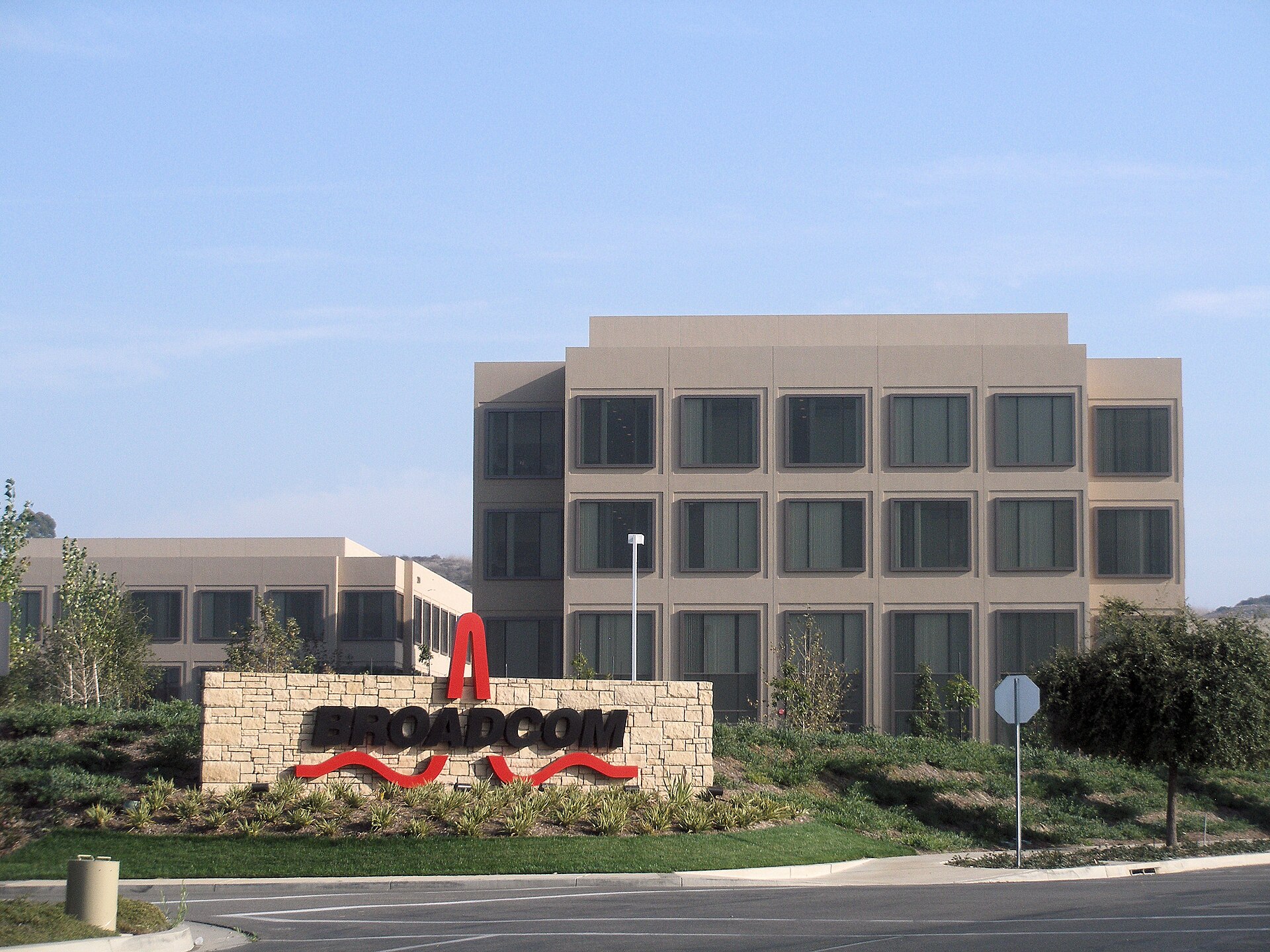
Broadcom stock closed Thursday at $291.53, down 10.43% in a single session as investors cut exposure to the semiconductor companies most directly tied to the AI data-center buildout.
The Philadelphia Semiconductor Index fell 12.3%, while the iShares Semiconductor ETF lost 12.8%. Benzinga described both moves as the sector’s worst since March 2020. Broadcom’s decline was smaller than the index drop, but it still took the stock almost back to its 52-week low of $289.96.
The numbers show how quickly the AI premium has been compressed. AVGO closed October 28 at $351.81. Eight days later it was at $291.53, a fall of more than $60 a share. It is also roughly 41% below its $495 52-week high.
The stock began recovering on Friday. It was around $297.39 at 11:37 a.m. ET, up about 2% from Thursday’s close, after trading above $310 earlier in the session. The bounce recovers only a fraction of Thursday’s loss.
For Broadcom investors, the next question is not simply whether the semiconductor index rebounds. It is whether the company’s custom AI accelerator and networking forecasts can support the valuation after investors suddenly put a lower price on continued data-center expansion.
Broadcom Fell 10.4% as the Chip Index Dropped 12.3%
Thursday’s semiconductor selloff was broad.
Benzinga’s closing table showed Micron down 17.5%, AMD down 17.3%, Marvell down 16.4%, Arm down 13.1%, Taiwan Semiconductor down 10.8%, Broadcom down 10.4% and Nvidia down 9.3%.
The Philadelphia Semiconductor Index lost 12.3%. Benzinga said that was its worst session since March 16, 2020, while the Nasdaq 100 fell 6.4%.
The selloff followed renewed concern that political resistance to data-center construction could slow the infrastructure spending behind the AI chip cycle. Reuters reported that investors were reassessing proposed projects after the U.S. midterm elections raised the prospect of tighter permitting, power and water restrictions in states where new data centers are planned.
FinanceFeeds covered the broader move in Wall Street Sheds $2.5 Trillion as Nasdaq Hits Correction, where Broadcom’s 10.4% fall sat alongside double-digit declines across memory, networking and data-center names.
The same repricing hit Nvidia. FinanceFeeds reported that Nvidia closed Thursday at $181.60 after a 9.3% decline, reinforcing that the selling was concentrated in companies whose earnings expectations depend heavily on continued AI infrastructure investment.
Broadcom Is Directly Exposed to the Data-Center Spending Question
Broadcom is not simply another large semiconductor stock caught in the index.
Its AI business is built around custom accelerators, or XPUs, designed for hyperscale customers, together with the networking silicon required to connect large clusters of accelerators inside data centers.
In its fiscal third quarter, Broadcom reported $16.7 billion of AI semiconductor revenue, up 221% from a year earlier. That represented more than half of the company’s $29.6 billion of quarterly revenue.
Broadcom guided fourth-quarter AI semiconductor revenue to approximately $21.7 billion, up 236% year over year, against total company revenue guidance of about $34.8 billion.
That means roughly 62% of the guided fourth-quarter revenue would come from AI semiconductors if both figures arrive as expected.
The exposure becomes even larger beyond the current quarter. Chief Executive Hock Tan said Broadcom expects AI revenue of approximately $115 billion in fiscal 2027 and around $230 billion in fiscal 2028.
Those forecasts explain why a slowdown in data-center construction matters so much to AVGO stock. Broadcom’s valuation increasingly reflects not only demand for today’s chips, but the assumption that hyperscalers keep adding compute capacity fast enough to absorb much larger volumes of custom silicon and networking equipment over the next two years.
AVGO Stock Is Now Near FinanceFeeds’ Previous Bear Case
The speed of Thursday’s decline also changes the reference points investors were using only days ago.
On October 29, FinanceFeeds modeled Broadcom at $427.47 in a year-end bull case, $333.63 in the base case and $282.82 in the bear case, using the prior 90 daily returns and the October 28 close of $351.81.
Thursday’s $291.53 close is already only $8.71 above that $282.82 bear level.
That does not make $282.82 a fundamental valuation or analyst target. The earlier FinanceFeeds exercise was a statistical price path, not an earnings model. But it shows how much of what had been considered a lower-tail move has already happened in little more than a week.
The stock is also now well below the $333.63 base path from that analysis.
Wall Street targets remain far higher. Benzinga’s analyst tracker on Friday showed an average Broadcom target of about $508, with 28 Buy ratings and three Holds. Those targets largely predate Thursday’s sector collapse, however, so they should not be read as analysts having reassessed the new policy and data-center risk at the $291.53 close.
Analysts Said the AI Trade Took Technical Damage Thursday
The commentary during Thursday’s rout reflected that divide between long-term AI demand and the price investors are willing to pay for it now.
Chris Zaccarelli, chief investment officer at Northlight Asset Management, told Benzinga that what began as weakness following Qualcomm and Arm’s results had turned into a broader market rout. He said the narrative had moved from enthusiasm that AI “changes everything” toward concern that new data centers could become harder to build.
Adam Turnquist, chief cross-asset strategist at LPL Financial, said the AI trade had suffered “significant technical damage.”
David Bahnsen, chief investment officer at The Bahnsen Group, was more cautious about treating the fall as a buying opportunity, arguing that technology-sector valuations remained too high even after the Nasdaq correction.
Those comments do not change Broadcom’s existing orders or its latest guidance. They do change what the market is demanding before it pays the previous multiple again.
Broadcom’s December Report Now Has to Defend the AI Forecast
Broadcom currently plans to report fiscal fourth-quarter and full-year 2026 results after the market closes on Wednesday, December 9. The company said on its September earnings call that the webcast would follow at 2:00 p.m. Pacific Time.
The immediate benchmark is straightforward.
Broadcom guided total fourth-quarter revenue to approximately $34.8 billion and AI semiconductor revenue to approximately $21.7 billion. Investors will also be listening for whether management still sees a path toward roughly $115 billion of AI revenue in fiscal 2027.
The networking side matters as much as the accelerator number. A slower buildout means fewer large accelerator clusters and therefore potentially less demand for the switches, interconnects and other networking silicon that Broadcom sells around them.
Thursday’s 10.4% fall did not prove that those forecasts are wrong. It showed that investors are no longer willing to price them with the same margin for error.
At $291.53, AVGO stock has moved from an AI-growth story trading near the middle of its recent range to a stock sitting just above its 52-week low and close to FinanceFeeds’ previous statistical bear case. The December 9 report now has to show whether the earnings trajectory fell with the share price, or whether only the multiple did.